

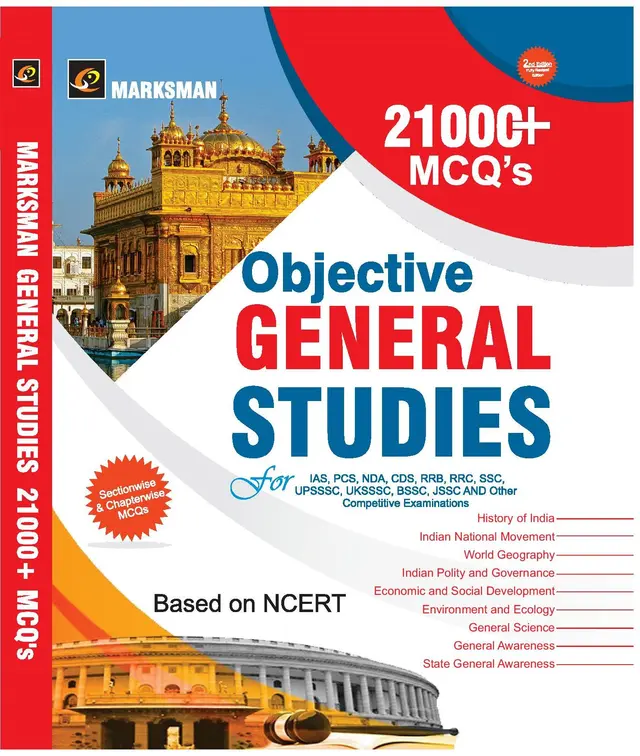
If you want a single, structured resource to drill every NCERT based topic for competitive exams, Objective General Studies 21000 MCQ Chapter-wise offers extensive chapter wise practice across subjects so you can identify gaps and track progress quickly. Use these 21,000 plus MCQs to build topic by topic mastery, sharpen exam speed, and convert passive study into measurable improvement.
You’ll find a clear breakdown of features, question types, and how to integrate such a large MCQ set into your study plan. Expect practical strategies for daily practice, targeted revision, and using chapter-wise organization to focus on weak areas without wasting time.
Objective General Studies 21000 MCQ Features
This book structures a very large MCQ bank into usable study blocks, links content to common competitive exams, and mirrors recent objective-question formats. You’ll find chapter-by-chapter sorting, mapped syllabus coverage, and examples of current MCQ trends.
Comprehensive Chapter-wise Organization
The book breaks subjects into chapter-level units that follow NCERT and standard state/UPSC syllabi. Each chapter contains clear topic headings, numbered MCQs, and answer keys for quick reference.
You can target weak areas by studying one chapter at a time and tracking progress with the chapter-wise counts of questions and solved examples.
Key layout elements:
- Chapter title + subtopics for quick scanning.
- Grouped MCQs (conceptual, factual, application) so you can practice each skill.
- Answer keys and brief explanations directly after chapters to save time.
This organization helps you plan revision sessions, create chapter tests, and focus on high-frequency topics such as Indian Polity, Modern History, and Environment.
Coverage of Key Competitive Exam Syllabi
The collection aligns with core topics across UPSC prelims and major State PCS exams, including General Science, Indian History, Geography, Economy, and Current Affairs. You’ll notice entries tagged or arranged to match common syllabus headings, making cross-referencing straightforward.
The book includes subjectwise totals and chapterwise breakdowns so you can compare coverage against your target exam’s official syllabus.
Practical features for exam preparation:
- Syllabus mapping — chapters mapped to exam sections (e.g., General Studies Paper I, State GK).
- Subjectwise MCQ counts — helps prioritize study time by weight.
- Past-year trend pointers — highlights chapters that frequently appear in prelims.
Latest MCQ Trends and Question Patterns
Question types reflect recent objective patterns: statement-based reasoning, assertion–reason formats, match-the-following sets, and data-interpretation blocks. You’ll practice multi-statement questions and application-style MCQs that test reasoning rather than rote recall.
The book also includes increasing numbers of environment, bioethics, and economy-policy questions, mirroring exam shifts in the last five years.
How this helps you:
- Practice on assertion–reason and multi-option formats to build exam stamina.
- Exposure to trend-specific topics (climate policy, digital governance) reduces surprises on test day.
- Varied difficulty levels within chapters let you progress from basic recall to high-order problem solving.
Effective Preparation Strategies for 21000 MCQ Sets
Target your daily study slots, revise topics by weight, practice under exam conditions, and track error patterns to convert quantity into mastery.
Time Management Techniques
Break the 21,000 MCQs into daily and weekly targets tied to your exam date. For example, schedule 120–150 questions daily if you plan to complete the set in 4 months. Block 60–90 minute focused sessions for new questions, followed by a 20–30 minute review of mistakes.
Use a weekly planner with three priority bands: Core (high-frequency topics), Moderate, and Light. Allocate 60% of active time to Core topics, 30% to Moderate, and 10% to Light. Build fixed slots for revision and one longer weekly session (3–4 hours) to consolidate learning.
Track time spent per question and reduce it gradually. Aim to shave seconds on routine items while preserving accuracy on conceptual items.
Mastering Subject-Wise Revision
Map the MCQ book’s chapters to subjects and mark chapters by past-paper frequency. Create a subject checklist indicating chapters you’ve completed, accuracy rate, and last revision date.
Use spaced repetition: revisit each chapter at 3-day, 10-day, and 30-day intervals after first completion. For factual subjects (dates, definitions), use flashcards; for conceptual subjects (economy, polity), write one-page summaries that capture key frameworks and exceptions.
Balance breadth and depth. Spend extra time on subjects that historically carry more weight in your target exam. Limit passive re-reading; instead, re-solve 20–30 representative questions per chapter during each revision pass.
Practice Mock Tests
Simulate exam conditions for full-length mocks: same timing, no resources, and realistic breaks. Schedule at least one full mock every 7–10 days during advanced preparation, and increase to two per week in the final month.
Use sectional timed tests for weak subjects. For example, allocate a Sunday to finish 100 polity MCQs in 90 minutes. Alternate between paper-based and digital mocks to build flexibility.
Record performance metrics for each mock: raw score, accuracy, time per question, and question-wise confidence level. Adjust mock difficulty gradually; include past-year papers and randomized chapter-wise sets from the 21,000 pool.
Analyzing Results for Improvement
Create an error log with columns: Question ID, Topic, Mistake Type (conceptual/factual/careless), Correct Answer, and Action Plan. Review this log weekly and mark recurring errors for targeted rework.
Use simple analytics: calculate subject-wise accuracy and average time per question. Flag topics with accuracy below 70% or time above your target as high-priority. For conceptual mistakes, re-study the underlying concept and solve 10 related questions within 48 hours.
Adopt corrective drills: after identifying a weak topic, do three focused sessions over a week — 20 mixed questions, one timed mini-test, and one open-book revision. Repeat until error recurrence drops below 10%.